时间:05/30/2026 05/31/2026
地点:星海禅修中心
主讲:净诚
佛法修行
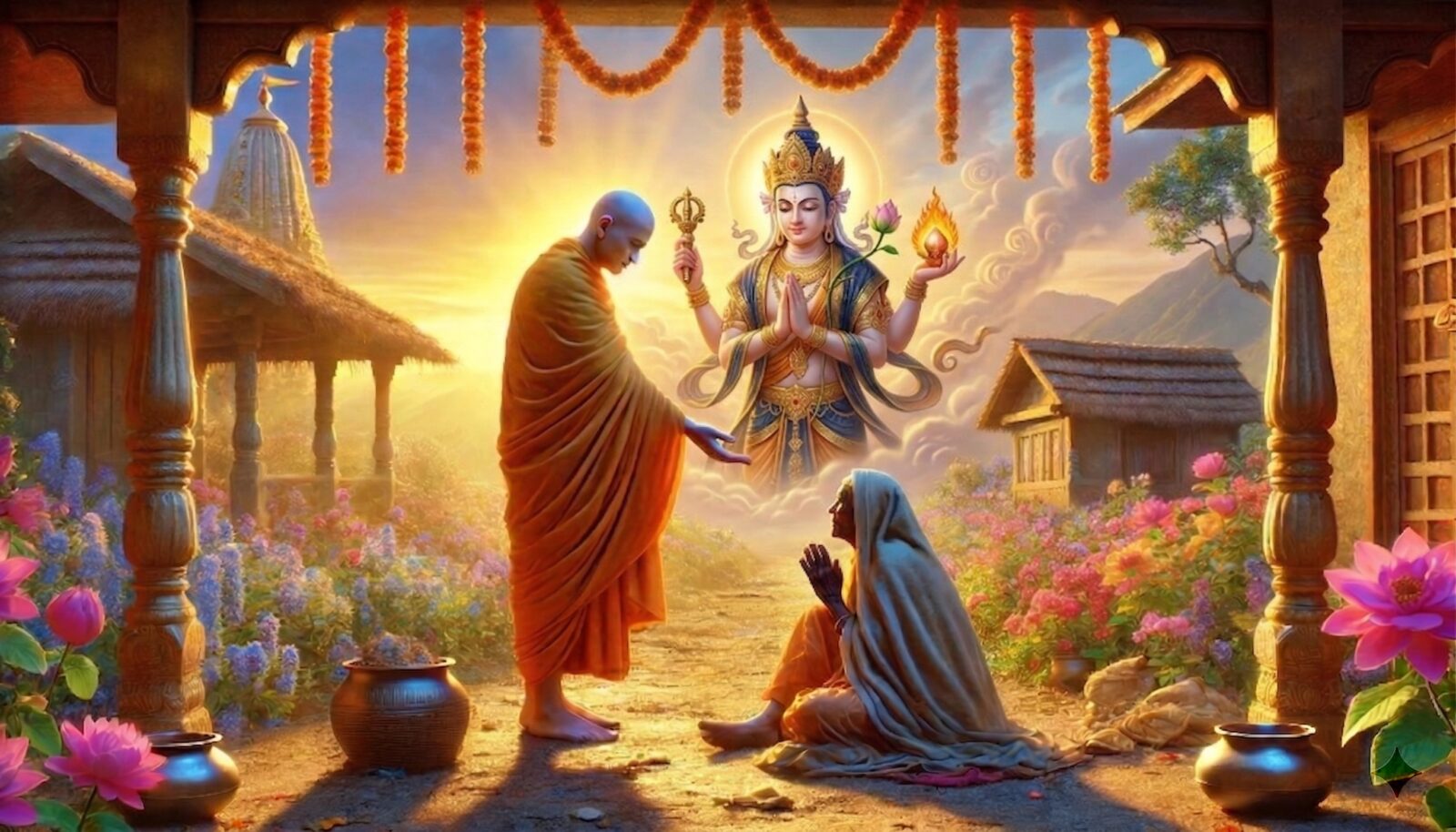
摩诃迦叶度贫母并帝释天
佛陀在舍卫国弘化之时,国王、臣民、出家比丘、比丘尼、菩萨大士、天、龙、鬼神,及世间无数人民,经常共集一处,听闻世尊讲经说法。
当时,佛陀的弟子摩诃迦叶常行慈悲,福惠众生,于乞食之时,舍豪富家而向贫穷人家乞食,给穷困者有种福田的因缘。有一天,摩诃迦叶独自行化到摩伽陀国的国都王舍城。他在定中观察到王舍大城中,有一孤苦无依的老妇人极为贫困,住在街巷边地的粪堆中,老妇人在粪聚土堆挖一个洞窟,用一片小篱笆隔在洞窟外,以遮蔽自己的形体。她身体枯弱,疾病缠身,常卧在洞窟中,孤单零丁,衣食不继。迦叶知道老妇因宿世不知布施种福田,所以今世如此贫穷困苦,又知道老妇即将命终,心想:「我今日若不去度化她,她将再也没有修福报的机会了!」
这一天,老妇人又饥又渴,有一位长者的仆人正要丢弃已经发臭的米汁,老妇人向仆人乞讨这恶臭难闻的米汁,用破碗装起带回洞窟,放在身边。此时,摩诃迦叶来到老妇人住处说道:「请多少布施我一些,妳将因此得大福报。」
老妇人听到乞食的声音,便说偈言:「举身得疾病,孤穷安可言,一国之最贫,衣食不盖形。世有不慈人,尚见矜愍怜,云何名慈哀,而不知此厄?普世之寒苦,无过我之身,愿见哀矜恕,实不为仁惜。」摩诃迦叶回答:「佛为三界尊,吾辈在其中,欲除汝饥贫,是故从贫乞。若能减身口,分铢以为施,长夜得解脱,后生得豪富。」老妇人又说:「实如仁所言,生世无功德,今在粪窟中,不净涂其身。饮食无分米,羸形而不覆,如今之极贫,施意与愿违。」摩诃迦叶重说偈言:「母说处不悦,饥穷无以施,若其有施意,此则不为贫。若复知惭羞,此则着法衣,如母此二事,衣食为备足。世有颛愚人,俗衣宝谷多,无惭不念施,计后此大贫。惶荒设福德,可谓为希有,信哉罪福众,至诚不虚说。」
老妇人听了摩诃迦叶至诚的劝化,生起欢喜心,想到身边只有臭米汁可以布施,但实在已经腐败酸臭,还能布施供养吗?于是请问:「您愿意哀愍我,接受我仅有的酸臭米汁吗?」摩诃迦叶回答:「妳的布施可谓大善!」
老妇人听到摩诃迦叶愿意接受,就端着仅有的臭米汁,慢慢爬向洞窟口,由于自己形体裸露,不能亲手奉上,于是侧身屈背,从小篱笆上递给迦叶。迦叶接过臭米汁,倒入自己钵中,随即祝愿:「妳种下布施的因,将来必能获福得安乐。」
迦叶心想:「如果我持往别处饮用,老妇会以为我丢弃,不相信我接受了她的布施。」迦叶即在老妇洞窟前饮尽臭米汁,用水洗钵后,将钵放进随身布囊。老妇亲眼看见迦叶一口饮尽臭米汁,真正相信他是为了施福与人,而接受布施。此时,迦叶思惟:「我应当现神足通,使老妇人更增信心,获大安乐。」于是,迦叶随即没入于地,又在虚空出现,身出水火,半身以上出水,半身以下出火;又在虚空中飞腾,从东方出现,隐没于西方,南方出现,隐没于北方,作种种神通变化。
这时,老妇人一心长跪,虔敬遥视迦叶种种神通变化,生起无比的恭敬与欢喜。迦叶问老妇人:「妳心里有什么愿望呢?想成为世间豪富、转轮圣王,或是四天王、释梵诸天?如果妳想成就须陀洹、斯陀含、阿那含、阿罗汉、辟支佛,乃至希望成就无上正等正觉的佛果,都可以满妳的愿。」
老妇人久居粪堆,贫病交迫,早已厌倦世间各种苦恼,曾听闻天上的生活甚为快乐,于是启禀迦叶:「我愿以这微薄的布施福报,生于天上。」迦叶听了老妇人的愿望后,随即隐身不见。数日后,老妇人命终,立即投生忉利天为天女。这位天女威德巍巍,震动天地,天女的光明显耀,胜过其他天众,犹如七个太阳同时照曜天宫。
释提桓因非常惊讶:「忉利天无人超过我的光明!是什么人?有何种福德能得此殊胜报身?」释提桓因以天眼观此天女,原来是因为福德招感使然。释提桓因即以偈问:「此女从何来?大光明照曜,譬如七大日,一时俱出现;震动吾宫殿,威德难可当,本修何福德,得来升此天?」天女回答:「本在阎浮提,粪窟不净中,羸老兼疾病,衣食不充备。三千大千土,释迦文佛尊,次有大弟子,名摩诃迦叶。哀矜从母乞,说法我心欢,贡其臭米汁,施少获愿多。一心供福地,愿欲生天上,弃身粪窟中,来生忉利天。」
天女进而思惟:「我现在能有大福报,实在是因为前世供养迦叶尊者,如果现在以天上种种百千珍宝供养迦叶尊者,犹不能报答尊者深恩于万一。」于是,天女带领侍女,手持天香、天华,顷刻间下到人间,于虚空中向迦叶散花,然后来到迦叶面前,五体投地顶礼迦叶。顶礼后,合掌恭敬赞叹:「大千国土,佛为特尊,次有迦叶,能闭罪门。昔在阎浮,粪窟之前,为其贫母,开说真言。时母欢喜,贡上米潘,施如芥子,获报如山。自致天女,封受自然,是故来下,归命福田。」
天女赞叹后,即与侍从返回天上。释提桓因心里想着:「此女前世住在阎浮提臭恶的粪窟中,只是以臭米汁供养迦叶,就能获得如此殊胜的福报,迦叶尊者实在是大慈大悲!但是他只给穷困人家修福的因缘,不会去大富豪家或是大姓人家乞食,我来想个好方法,亲自去阎浮提兴设供养,希望迦叶尊者能接受,以求福祐。」
释提桓因与天后,将百味佳肴浓缩,盛装在小瓶中,下到人间的王舍大城,在巷道边搭建了一间简陋的小屋,夫妇二人隐藏天人的身相,将自己变成瘦弱的老人,弯腰驼背,步履蹒跚,家徒四壁,毫无存粮,亦无衣被等物,二人编织草蓆为生,现出贫穷人的样子。
摩诃迦叶乞食时,经过此处,见这两位贫困的老夫妇,便前往乞食,老人说:「我们清贫如洗,一无所有,怎么办呢?」迦叶仍然站在门口,祝愿布施得福,久久未离去。老人说:「我们已经很衰老,靠织蓆为生,无能力炊事,我们乞讨了少许饭,正想食用。但听说仁者大慈愍,都是从贫困人家乞食,使贫困人有修福的机会;虽然我们穷困,但是恳切愿意将少许饭供养仁者,期望能如大众所说,因为布施供养而得福。」
老人想,天食之香不是世间饮食能相比,若是预先打开百味佳肴小瓶,其香必定被迦叶知道,而不肯接受。老人说:「我这粗弊之食不多,请以钵取食。」迦叶随即祝愿布施者得福,并说:「施家所施食之香,普薰王舍大城及其国界。」天食实在妙香异常,迦叶即刻入定观察缘故。迦叶刚入定,这对老人随即恢复帝释天及天后身,极快速地飞离,弹指间已在虚空,两人因为供养了迦叶,生起无量欢喜心。
迦叶入定观察,知是帝释化作贫困老人,希望因为供养而增福,既然已经接受帝释的布施,就不适宜再退还了。于是迦叶赞叹:「善哉!帝释!累劫以来,善耕种种福田,从未疲厌,现今以帝释之尊,化作丑陋的贫穷老人,下至人间积福修德,祝愿帝释将来所获福报,如影随形。」帝释及天后听了迦叶的祝愿,更为欢欣踊跃。这时,天人以天乐来迎接帝释返回天宫,帝释夫妇实践了供养迦叶尊者的愿望,内心欢喜,不可言喻。
佛告诉阿难:「这位贫穷老妇人的布施,是一切世间人所无法相比,老妇人生活极为困苦,却能诚敬布施其仅有微少的臭米汁,获无量福,是因至诚心所感得的福报。释提桓因在忉利天,可以随心所欲享受天福,却愿放下尊贵的身分,下来人间供养植福,将来所获福报,难思难量,所以如来常宣说,布施波罗蜜为第一。豪贵的人或是贫困的人,能够如释提桓因或穷苦老妇这样知道布施修福,实在是少之又少。弟子们!应当广为宣说布施的重要,将佛法真理弘扬于世间。」
此时,天、龙、鬼神、四众弟子、比丘僧等,都兴设大福,布施供养,并回向发愿,希望一切众生皆能随喜布施,得善果报。与会大众个个生起欣乐之心,顶礼世尊,依教奉行。
Date: 05/30/2026 05/31/2026
Location: Star Ocean Meditation Center
Teacher: Jason
Dharma Talk
Mahākāśyapa Saves the Poor Mother and Śakra Devānām Indra
When the Buddha was teaching in Śrāvastī, kings, ministers, monastics, bhikṣus, bhikṣuṇīs, great bodhisattvas, devas, dragons, spirits, and countless people of the world often gathered together in one place to hear the World-Honored One expound the sūtras and teach the Dharma.
At that time, Mahākāśyapa, a disciple of the Buddha, constantly practiced compassion and bestowed blessings upon living beings. When going on alms rounds, he would pass by the homes of the wealthy and instead seek alms from poor households, thus giving the destitute an opportunity to plant fields of merit. One day, Mahākāśyapa traveled alone to Rājagṛha, the capital of Magadha. In meditation, he observed that within the great city there was an old woman, utterly destitute and without support, living in a heap of refuse by the roadside. She had dug a cave into a mound of filth and earth, placing a small fence outside to cover her body. Her body was emaciated, she was afflicted by illness, and she often lay in the cave, alone and forsaken, without sufficient clothing or food. Kāśyapa knew that because in past lives she had not understood giving or planting merit, she now suffered such poverty and hardship. He also knew that her life was soon to end, and he thought, “If I do not save and guide her today, she will never again have the chance to cultivate blessings.”
On that day, the old woman was both hungry and thirsty. A servant of an elder was about to discard some rice water that had already turned foul. The old woman begged the servant for the putrid and foul-smelling rice water, collected it in a broken bowl, and brought it back to her cave, placing it by her side. At that moment, Mahākāśyapa came to where she lived and said, “Please give me a little in alms, and through this you will gain great merit.”
Hearing the sound of one asking for alms, the old woman spoke in verse: “My whole body is diseased; how can one speak of such lonely poverty? I am the poorest in the land, with neither clothing nor food enough to cover my form. There are people in the world who are not compassionate, yet they still show pity and sympathy. How is it that one called kind and merciful does not understand this suffering? Of all the cold and bitter hardship in the world, none surpasses my own body. I beg you to show pity and forbearance; truly it is not that I begrudge the benevolent.” Mahākāśyapa replied, “The Buddha is the Honored One of the three realms, and we dwell within his teaching. I wish to remove your hunger and poverty; therefore I beg from the poor. If one can reduce one’s own mouth and body and give even the smallest fraction in alms, then through the long night one will attain liberation, and in future lives gain wealth and honor.” The old woman again said, “It is indeed as you say. In this life I have no merit. Now I dwell in a filthy cave, smeared with impurity upon my body. My food has not even grains of rice, and my emaciated body is not covered. In such extreme poverty, my wish to give runs contrary to my circumstances.” Mahākāśyapa again spoke in verse: “Mother, though what you say is sorrowful, hunger and poverty do not mean one cannot give. If there is the intention to give, then this is not true poverty. If one also knows shame and modesty, this is to wear the robe of Dharma. If, like you, one has these two qualities, then clothing and food are already complete. In the world there are ignorant fools who possess worldly garments, treasures, and abundant grain, yet without shame and without thoughts of giving, they are reckoning for a great poverty in what comes after. To establish merit amid fear and desolation is indeed most rare. Truly, among sins and blessings, sincere words are never false.”
After hearing Mahākāśyapa’s utterly sincere exhortation, the old woman gave rise to joy. She thought that the only thing beside her that she could offer was the foul rice water, but it was already rotten and sour. Could such a thing still be offered? So she asked, “Would you be willing to pity me and accept the little sour and fetid rice water that I possess?” Mahākāśyapa replied, “Your offering may indeed be called a great good deed.”
Hearing that Mahākāśyapa was willing to accept it, the old woman held up her only bowl of foul rice water and slowly crawled toward the mouth of the cave. Because her body was uncovered, she could not present it with her own hands. So she turned sideways, bent her back, and passed it over the little fence to Kāśyapa. Kāśyapa accepted the foul rice water, poured it into his bowl, and at once pronounced a blessing: “You have planted the cause of giving; in the future you will surely obtain blessings, peace, and joy.”
Kāśyapa thought, “If I take this elsewhere to drink it, the old woman may think I have discarded it and will not believe that I accepted her offering.” So right in front of her cave, he drank the foul rice water to the last drop. After washing his bowl with water, he placed it into his cloth bag. Seeing with her own eyes that Kāśyapa had drained the foul rice water in one draught, the old woman truly believed that he had accepted her offering in order to bestow merit upon others. At that moment Kāśyapa reflected, “I should now display spiritual powers, so that the old woman’s faith may increase and she may attain great peace and joy.” Thereupon he immediately sank into the earth and then appeared in the sky, emitting water and fire from his body, with water issuing from the upper half and fire from the lower half. He then soared through the air, appearing in the east and vanishing in the west, appearing in the south and vanishing in the north, performing all manner of miraculous transformations.
At that time, the old woman knelt with single-minded devotion, reverently gazing from afar at Kāśyapa’s various displays of spiritual power, and gave rise to incomparable reverence and joy. Kāśyapa asked her, “What wish do you hold in your heart? Do you wish to become one of the wealthy of the world, a Wheel-Turning Sage King, or one of the Four Heavenly Kings, or among the heavens of Śakra and Brahmā? If you wish to attain the fruit of stream-entry, once-returning, non-returning, arhatship, pratyekabuddhahood, or even the unsurpassed, complete, and perfect awakening of Buddhahood, all of these wishes may be fulfilled for you.”
The old woman had long dwelt in a heap of refuse, oppressed by poverty and illness, and had long since grown weary of all worldly suffering. She had heard before that life in the heavens was exceedingly joyful, and so she said to Kāśyapa, “I wish, through the merit of this slight act of giving, to be born in heaven.” After hearing the old woman’s wish, Kāśyapa at once disappeared. Several days later, the old woman died and was immediately reborn in Trāyastriṃśa Heaven as a heavenly maiden. This heavenly maiden possessed awe-inspiring majesty that shook heaven and earth. Her radiance shone more brilliantly than that of the other celestial beings, like seven suns shining at once upon the heavenly palace.
Śakra Devānām Indra was greatly astonished: “In Trāyastriṃśa Heaven no one surpasses my light! Who is this person? By what merit has she obtained such a wondrous reward-body?” With his divine eye, Śakra observed the heavenly maiden and saw that it was brought about through the ripening of merit. Śakra then asked in verse: “From where has this maiden come? Her great radiance shines forth, like seven great suns appearing all at once. She shakes my palace; her majesty is hard to withstand. What blessings did she cultivate to ascend to this heaven?” The heavenly maiden replied: “Formerly I was in Jambudvīpa, in an impure pit of filth, weak with age and sickness, lacking enough clothing and food. In the three-thousand great-thousand world, there is the Buddha Śākyamuni, and next among his great disciples is one named Mahākāśyapa. Out of pity he begged from this mother; as he preached Dharma, my heart rejoiced. I offered him foul rice water. Though the gift was small, the reward fulfilled my great wish. With one-pointed mind I made offering to a field of merit, wishing to be born in heaven. Leaving behind my body in the pit of refuse, I have now been reborn in Trāyastriṃśa Heaven.”
The heavenly maiden then reflected further: “That I now possess such great merit is truly because in a former life I made offerings to the Venerable Kāśyapa. Even if I were now to offer him all the hundreds of thousands of treasures of heaven, I could still not repay even a ten-thousandth part of his profound kindness.” Therefore, the heavenly maiden led her attendants, carrying heavenly incense and heavenly flowers, and in an instant descended to the human world. From the sky she scattered flowers toward Kāśyapa, then came before him and prostrated herself fully at his feet. After bowing, she placed her palms together and reverently praised him: “In the great thousand world-systems, the Buddha is uniquely honored; next is Kāśyapa, who can close the gate of sin. Formerly in Jambudvīpa, before the pit of refuse, he opened and proclaimed true words for that poor mother. At that time the mother rejoiced and offered up rice gruel. Though the gift was like a mustard seed, the reward was like a mountain. Thus I became a heavenly maiden and naturally received such recompense. Therefore I have come down to take refuge in this field of merit.”
After praising him, the heavenly maiden returned to heaven with her attendants. Śakra Devānām Indra thought to himself, “This maiden in her former life lived in a foul pit of refuse in Jambudvīpa. Merely by offering foul rice water to Kāśyapa, she obtained such a wondrous reward. The Venerable Kāśyapa is truly of great compassion! Yet he gives only the poor the opportunity to cultivate merit, and he will not go to rich or noble families for alms. I shall think of a good method, personally go to Jambudvīpa, and establish an offering, hoping that the Venerable Kāśyapa will accept it so that I may seek blessings.”
Śakra Devānām Indra and his queen concentrated a hundred flavors of exquisite heavenly food and placed them in a small bottle. They descended to the great city of Rājagṛha in the human world and built a crude little hut by the roadside. The husband and wife concealed their heavenly forms and transformed themselves into frail old people, bent at the waist and stooped in the back, walking with difficulty, their home bare on all sides, without any stored grain, clothing, or bedding. The two made a living by weaving grass mats, appearing exactly like poor people.
While Mahākāśyapa was on alms round and passed by that place, he saw the poor old couple and went to seek alms there. The old man said, “We are utterly destitute and have nothing at all. What can we do?” Kāśyapa still stood at the doorway, blessing the donors so that they might gain merit, and did not leave for a long time. The old man said, “We are already very old and live by weaving mats. We have no strength to cook. We begged a little food and were just about to eat it. But we have heard that the benevolent one, out of great compassion, always seeks alms from poor families, giving the poor a chance to cultivate merit. Though we are poor, we sincerely wish to offer this little food to the benevolent one, hoping, as people say, to gain blessings through giving and making offerings.”
The old man thought, “The fragrance of heavenly food is unlike any food in the human world. If I open the little bottle of a hundred-flavored delicacies beforehand, its fragrance will surely be recognized by Kāśyapa, and he will refuse to accept it.” So the old man said, “This coarse food of mine is not much; please receive it in your bowl.” Kāśyapa at once pronounced blessings for the donor and said, “The fragrance of the food offered by this household now spreads through the great city of Rājagṛha and throughout its realm.” The heavenly food was indeed wondrously fragrant beyond measure, and Kāśyapa immediately entered meditation to observe the cause. The moment Kāśyapa entered samādhi, the old couple at once resumed the forms of Śakra and his queen, and flew away with utmost speed, reaching the sky in the time of a finger snap. Because they had made offerings to Kāśyapa, both gave rise to immeasurable joy.
In meditation, Kāśyapa observed and understood that it was Śakra who had transformed himself into a poor old man, wishing to increase his merit through making offerings. Since he had already accepted Śakra’s gift, it would not be proper to return it. Therefore Kāśyapa praised him, saying, “Excellent indeed, Śakra! For countless kalpas you have diligently cultivated all kinds of fields of merit without ever growing weary. Now, though honored as Śakra, you have transformed yourself into an ugly and poor old man, descending to the human world to accumulate blessings and cultivate virtue. May the blessings you obtain in the future follow you as inseparably as a shadow.” Hearing Kāśyapa’s blessing, Śakra and his queen were even more delighted and jubilant. At that moment, celestial beings came with heavenly music to escort Śakra back to his heavenly palace. Śakra and his queen had fulfilled their wish to make offerings to the Venerable Kāśyapa, and the joy in their hearts was beyond words.
The Buddha told Ānanda, “The giving of this poor old woman is something that no person in the world can compare with. Though her life was extremely bitter and difficult, she was still able, with sincerity and reverence, to offer the only tiny amount of foul rice water that she possessed, and thus gained immeasurable blessings. This was the reward brought forth by the utmost sincerity of her mind. Śakra Devānām Indra in Trāyastriṃśa Heaven may enjoy heavenly blessings as he pleases, yet he was willing to set aside his noble status and descend to the human world to make offerings and plant merit. The blessings he will obtain in the future are beyond thought and beyond measure. Therefore, the Tathāgata constantly proclaims that the pāramitā of giving is foremost. Whether wealthy and noble or poor and humble, those who know how to cultivate merit through giving, like Śakra or that poor old woman, are truly very rare. Disciples, you should widely proclaim the importance of giving and spread the truth of the Buddha-Dharma throughout the world.”
At that time, devas, dragons, spirits, the fourfold assembly, bhikṣus, and the rest all established great merit through giving and making offerings, and dedicated their vows, hoping that all sentient beings might rejoice in giving and obtain wholesome retribution. Every person in the assembly gave rise to joyful delight, bowed to the World-Honored One, and practiced according to the teaching.