时间:05/10/2025 05/11/2025
地点:星海禅修中心
主讲:净真
佛法知识
在家庭中修行
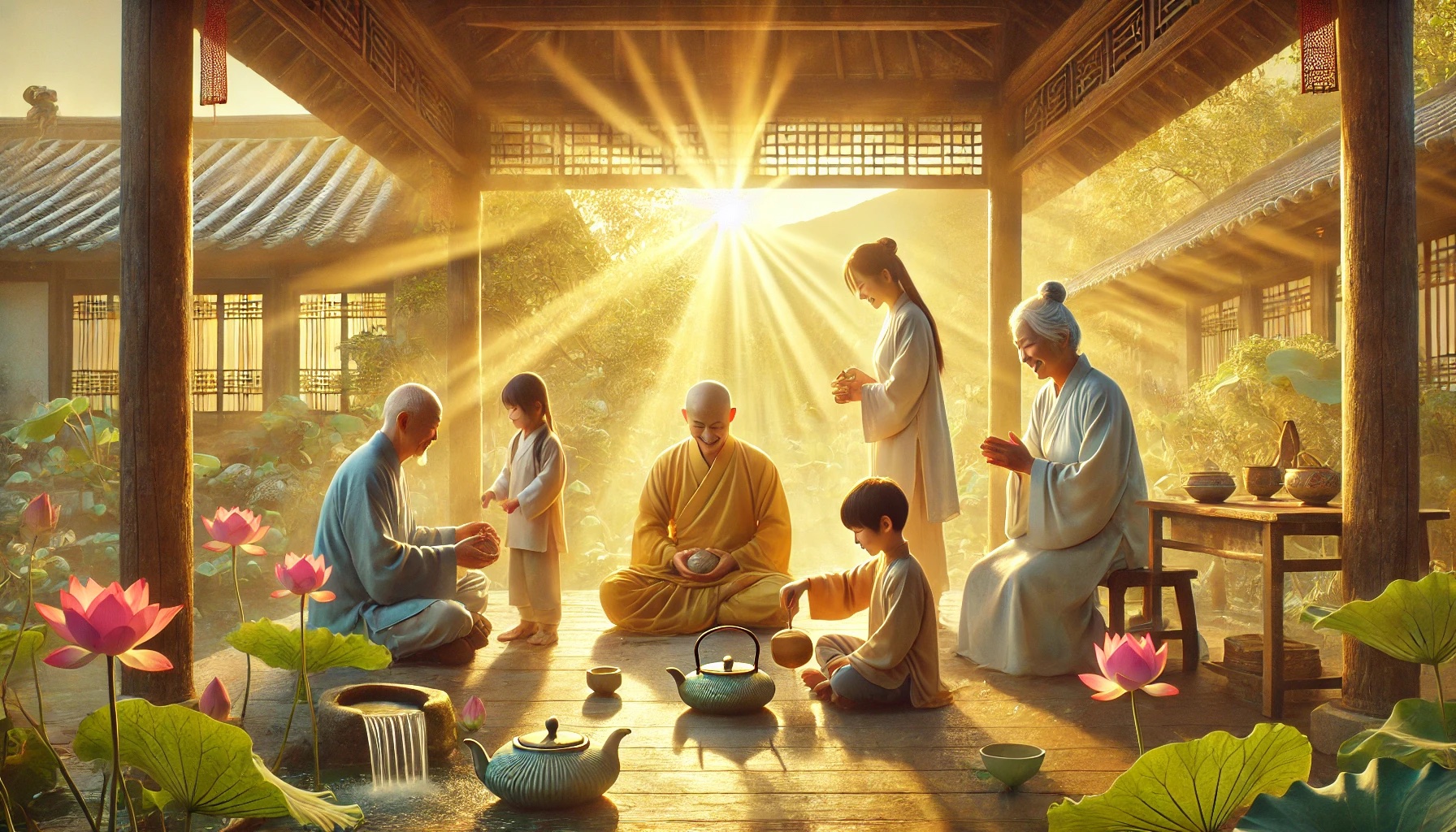
“在家庭中修行”常被误解为一种折中方案,仿佛真正的修行应当远离家庭,而家庭只是不得不接受的现实条件。事实上,这种看法本身就建立在对修行与生活的错误划分之上。从佛法立场看,修行不依附于场所、身份或形式,而取决于是否如实观察身心运作、是否持续削弱无明与执取。由此而言,家庭既不是修行的障碍,也不是特殊场域,而是最直接、最完整的修行环境。
家庭的本质,是高度密集的因缘关系。亲密关系意味着情绪频繁被触发,角色认同持续被强化,责任与期待不断交织。这些特征在世俗语境中被视为压力来源,但在佛法视角中,它们恰恰构成了观察“苦如何产生”的理想条件。若修行的目标是如实理解贪、嗔、痴的运行机制,那么家庭生活提供了持续而稳定的观察素材。
在家庭中修行,首先面临的是“角色执取”的问题。父母、配偶、子女等身份,本质上是社会与关系中约定的功能标签,但人在其中极易将角色误认为“自我”。一旦角色被固化,任何偏离期待的行为都会引发情绪反应。修行并非否定角色,而是在履行角色功能的同时,看清其非自性、不恒常、不等同于“我”。这一观察本身,即是对无明的削弱。
其次,家庭修行并不等同于情绪压抑或道德表演。佛法并不要求修行者在家庭中维持某种“温和形象”,更不主张以忍让掩盖未被理解的烦恼。真正的修行,是在情绪生起时如实觉知其条件,而非急于压制或合理化。当愤怒、委屈、控制欲出现时,问题不在于它们“该不该出现”,而在于是否被清楚看见、是否被自动认同。
在行为层面,家庭中的戒并非宗教规范,而是因果理性。伤害性的语言、操控性的行为、基于恐惧的决策,都会在关系中制造长期不稳定的条件。持戒的意义,在于减少制造新的因缘纠缠,使心有条件保持清明。这不是道德要求,而是对因果结构的理解。
在心的训练上,家庭环境并不排斥定,反而检验定的真实性。若一种专注只能在隔离环境中成立,而在日常互动中迅速崩解,那么它尚未转化为稳定能力。家庭中的噪音、琐事与冲突,正是检验心是否真正具备可回收性的标准。
至于慧,家庭修行提供了极为具体的切入口。无常并非抽象概念,而体现在孩子的成长、关系的变化、情绪的反复;无我并非哲学命题,而体现在“我以为应该如此”的不断失败;苦也不再是理论,而是每天可被直接观察的现实。若这些现象不能被用来发展智慧,那么任何远离生活的理解都只是概念堆积。
需要澄清的是,在家庭中修行,并不意味着家庭本身会因此变得和谐、理想或“像修行道场”。佛法不保证关系顺利,只提供理解关系的工具。修行的结果,不是他人改变,而是自身不再以错误方式参与关系。这一点若未被看清,修行极易退化为对家人的隐性要求。
因此,在家庭中修行的核心,不是平衡家庭与修行,而是取消二者的对立。家庭不是修行的替代品,也不是妨碍物,而是一套完整的现实系统。能否修行,不取决于是否出家,而取决于是否在最容易起执取之处,持续保持清醒。
Date: 05/10/2025 05/11/2025
Location: Star Ocean Meditation Center
Teacher: Sara
Dharma Knowledge
Practicing the Dharma Within Family Life
“Practicing the Dharma within the family” is often misunderstood as a compromise, as if genuine practice requires withdrawal from family life and the household is merely an unavoidable constraint. From the standpoint of the Dharma, this division is mistaken. Practice does not depend on location, status, or form, but on whether ignorance and attachment are being directly observed and weakened. In this sense, family life is neither an obstacle nor a special concession—it is one of the most direct fields of practice available.
A family is a dense network of conditions. Emotional triggers are frequent, identity roles are continuously reinforced, and responsibility and expectation are tightly interwoven. In ordinary terms, these are sources of stress. From the perspective of the Dharma, they are ideal conditions for observing how suffering arises. If practice aims to understand the mechanisms of craving, aversion, and confusion, then family life provides constant and reliable material for investigation.
The first issue encountered in family practice is attachment to roles. Parent, spouse, and child are functional designations within relationships, yet they are easily mistaken for fixed identity. Once a role is taken as “self,” any deviation from expectation generates emotional disturbance. Practice does not require rejecting roles, but performing their functions while clearly seeing their impermanent and non-self nature. This discernment directly undermines ignorance.
Practicing in the family does not mean suppressing emotion or performing moral restraint for appearance’s sake. The Dharma does not demand a calm persona, nor does it endorse endurance that conceals unexamined distress. Genuine practice is the clear recognition of conditions when emotions arise. Anger, resentment, and control impulses are not problems because they appear, but because they are unconsciously identified with. Seeing them as conditioned processes is the practice.
On the level of conduct, ethical restraint within the family is not a religious rule but an application of causal understanding. Harmful speech, manipulative behavior, and fear-driven decisions generate unstable conditions that perpetuate suffering. Ethical discipline functions to reduce unnecessary entanglement and preserve mental clarity. Its basis is pragmatic, not moralistic.
Regarding mental stability, family life does not exclude concentration—it tests it. A form of calm that survives only in isolation but collapses in ordinary interaction is not yet integrated capacity. Noise, interruptions, and conflict reveal whether attention can be regained without resistance. In this sense, the household becomes a continuous measure of mental training.
Wisdom, likewise, finds concrete expression in family life. Impermanence is visible in aging, growth, and shifting relationships. Non-self becomes evident in the repeated failure of “how things should be.” Suffering is no longer theoretical, but directly observable in daily interaction. If these phenomena do not contribute to insight, then understanding remains abstract and untested.
It is essential to clarify that practicing within the family does not mean the family will become harmonious, ideal, or resemble a retreat environment. The Dharma does not promise relational success. It provides tools for understanding conditions. The result of practice is not the transformation of others, but the cessation of one’s own participation in confusion. When this distinction is overlooked, practice easily turns into covert expectation.
Therefore, the core of family practice is not balancing family and practice, but dissolving their opposition. The family is neither a substitute for practice nor a hindrance to it, but a complete reality system. Whether practice occurs depends not on renunciation of life, but on sustained clarity precisely where attachment most readily arises.