时间:02/20/2027 02/21/2027
地点:星海禅修中心
主讲:净诚
佛法修行
须曼花衣随身产缘
过去,佛陀在舍卫国祇树给孤独园弘法时,城中有位大富长者,娶了名门贵族之女为妻。长者还特别聘请城中最好的乐师,每日演奏种种上妙音乐,来取悦夫人。
长者夫人怀妊十月后,不仅产下一名相貌端严的男婴,且一生下来,身上即裹着一件由须曼花编织而成的衣裳,不但柔软无比且色彩缤纷,同时还透露着一股世间少有的清香,闻之令人神清气爽。为此,长者特别请来占相师为儿子看相,相师们看到男婴端正殊妙的相貌都赞叹不已,于是纷纷询问长者:“孩子出生的过程,有什么瑞相吗?”长者夫妇回答:“孩子身上的须曼花衣是与生俱来的。”相师们听了都觉得不可思议,因此为男婴取名为“须曼那”。
须曼那在父母的慈爱中,一天天长大。他的个性谦和,对人总是温和有礼,对于父母亲更是孝顺,大家都很喜欢亲近他。更不可思议的是,身上的须曼花衣也随着他的身形成长而变化,始终合身。长者夫妇知道须曼那身上能有这件庄严的须曼花衣,一定有其特殊因缘,便让须曼那前往给孤独园出家修行,并依阿那律尊者学习坐禅等法门。出家后的须曼那沙弥,非常用心学习。在阿那律尊者的教导下,不久就证得阿罗汉果,得三明六通,具八解脱,为诸天世人所敬仰。
一天,阿那律尊者令须曼那到远方的拔提河去汲取净水,供养佛陀。于是须曼那前往拔提河,将净瓶装满水之后,往空中一掷,净瓶竟飘浮于空中,跟随着须曼那往竹林精舍飞来。当时在给孤独园中的比丘们见到这番情形,都非常讶异,在得知须曼那只是出家未久的沙弥后,对于须曼那能具有如此神通,更是叹未曾有。于是,大众比丘恭敬地请示佛陀:“世尊,须曼那沙弥在过去生究竟修了什么样的福报,不仅今世出生于富贵人家,又有须曼花衣随身俱生,更在出家不久后,证得阿罗汉果?”于是,佛陀为大众比丘慈悲开示其中的因缘。
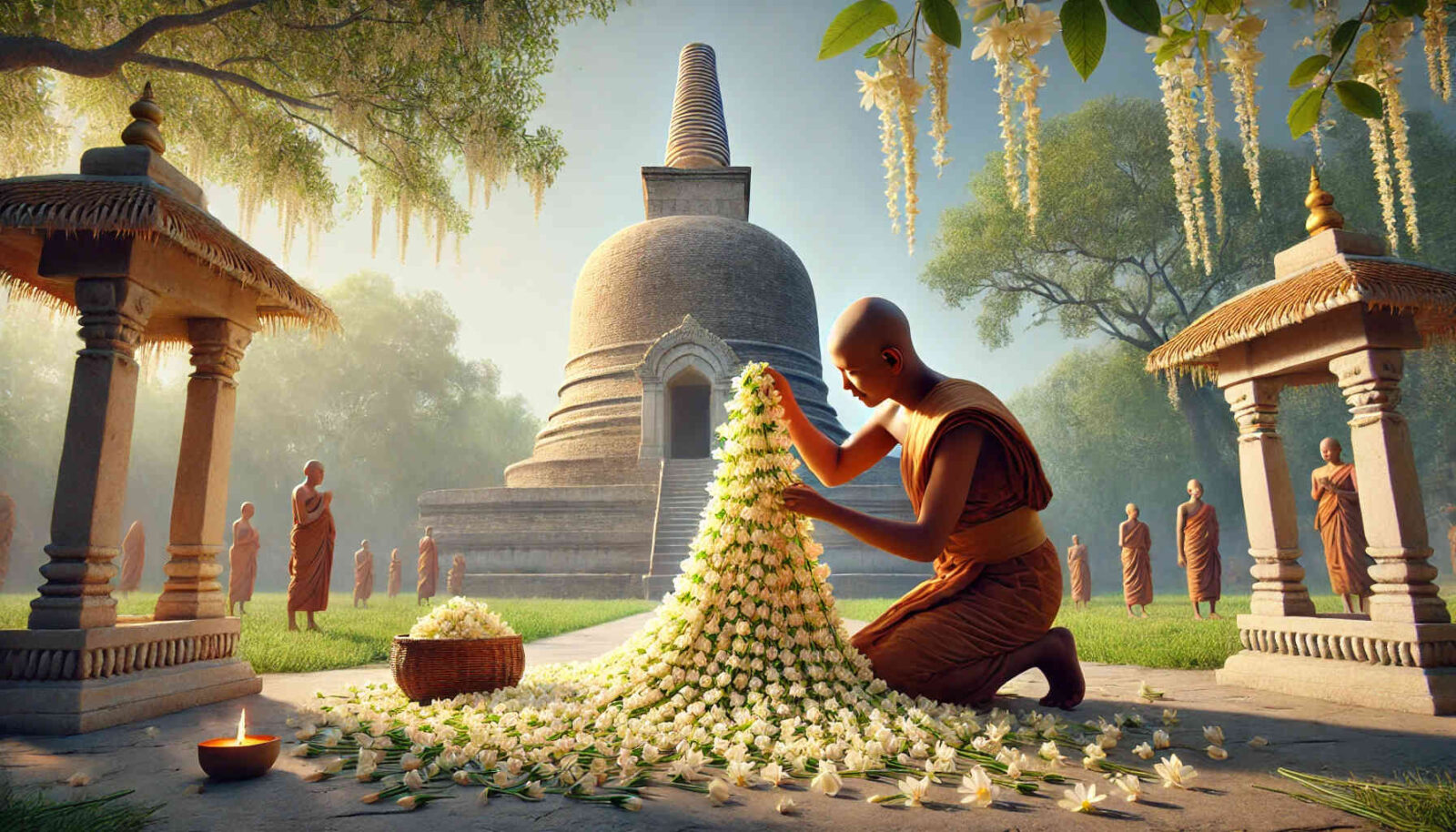
过去九十一劫前,有毗婆尸佛住世,在波罗奈国弘扬佛法,教化百姓,功德圆满后,入于涅槃。当时的梵摩达多王为佛弟子,于佛涅槃后,发心建造四宝塔供养佛舍利。当时有一童子,前往瞻仰礼敬宝塔,看到殊胜庄严的宝塔后,心生欢喜,因而发愿出家;然而及至年老,都未曾开悟,于是深自呵责忏悔。一天,比丘以其所有积蓄,购买须曼花,亲自以细线将一朵朵的须曼花缝制成一件能够盖满宝塔的须曼花衣,供养佛舍利塔,并且发愿生值佛世,随佛出家,证悟道果。
佛陀告诉大众:“此比丘由此供养功德,九十一劫以来不堕地狱、畜生、饿鬼,不论天上、人间,常有须曼花衣与身俱生,享受天人福报。更由于忏悔发愿功德,于今世得遇佛出世,随佛出家而证道果。”诸比丘闻佛所说,皆信守教诲,欢喜奉行。
Date: 02/20/2027 02/21/2027
Location: Star Ocean Meditation Center
Teacher: Jason
Dharma Talk
The Karmic Cause of Being Born with a Sumanā Flower Garment
In the past, when the Buddha was teaching the Dharma at Jetavana in Śrāvastī, there was a great wealthy elder in the city who married a noble lady. He even hired the finest musicians to perform exquisite music daily to please his wife.
After ten months of pregnancy, the elder’s wife gave birth to a dignified and handsome boy. At the moment of birth, the child was wrapped in a garment woven from Sumanā flowers. It was incomparably soft, brilliantly colored, and emitted a rare fragrance that refreshed all who smelled it. The elder invited physiognomists to examine the child. Seeing his extraordinary appearance, they praised him and asked, “Were there any auspicious signs at his birth?” The parents replied, “The Sumanā flower garment was present at birth.” Amazed, the physiognomists named the child “Sumanā.”
Raised with loving care, Sumanā grew day by day. He was gentle, courteous, and filial, and everyone enjoyed his company. Even more remarkable, the flower garment grew with his body, always fitting perfectly. Knowing this must be due to special karmic causes, his parents sent him to Jetavana to ordain, where he studied meditation under Venerable Aniruddha. As a novice, he practiced diligently, and before long attained arhatship, achieving the three knowledges, six supernatural powers, and eight liberations, and was revered by gods and humans alike.
One day, Venerable Aniruddha instructed Sumanā to fetch pure water from the distant Bhadra River as an offering to the Buddha. After filling the vessel, Sumanā cast it into the air, where it floated and followed him back to the Bamboo Grove Monastery. The monks, seeing this, were astonished. Learning that he was newly ordained, they marveled at his powers and asked the Buddha, “What merit did Sumanā cultivate in past lives to be born wealthy, endowed with such a garment, and attain arhatship so swiftly?” The Buddha then explained the causes and conditions.
Ninety-one kalpas ago, during the time of Buddha Vipaśyin, who taught in Bārāṇasī and later entered nirvāṇa, King Brahmadatta, his disciple, built a jeweled stupa to enshrine the relics. A youth came to pay homage, rejoiced upon seeing the stupa, and aspired to ordain. However, he failed to attain awakening even in old age and deeply repented. One day, he used all his savings to purchase Sumanā flowers and personally sewed them into a garment large enough to cover the stupa, offering it to the Buddha’s relics and vowing to be reborn in a Buddha’s era, to ordain and realize the path.
The Buddha told the assembly, “Through this offering, for ninety-one kalpas he did not fall into hell, the animal realm, or the realm of hungry ghosts. Whether in heaven or among humans, he was always born with a Sumanā flower garment, enjoying great blessings. Moreover, through repentance and vows, he now encounters the Buddha, ordains, and attains the path.” Hearing this, the monks faithfully accepted the teaching and rejoiced in its practice.