时间:08/10/2024 08/11/2024
地点:星海禅修中心
主讲:净真
佛法知识
四圣谛的由来
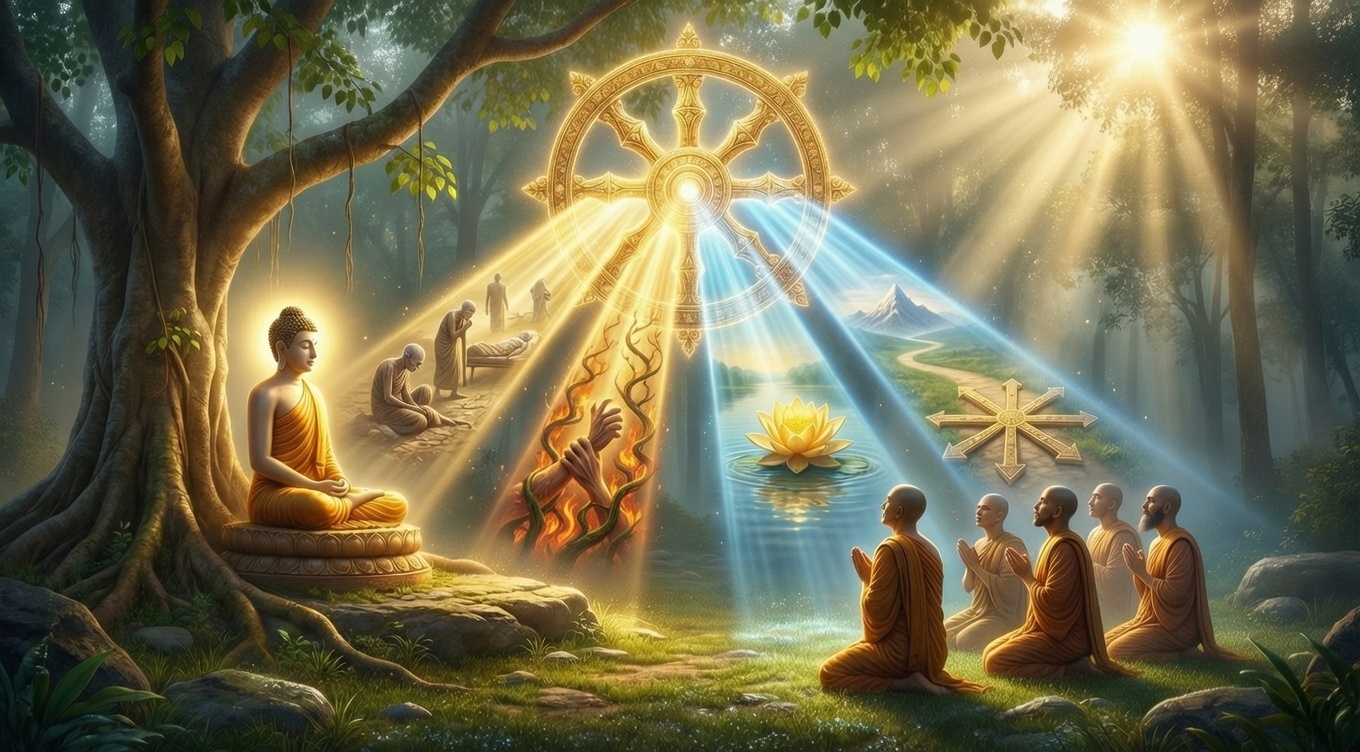
四圣谛并非先验教义,也不是抽象哲学框架,而是佛陀在证悟过程中,对“苦如何成立、又如何止息”这一问题所作出的最小且完整的结构化总结。理解四圣谛的由来,关键不在于背诵其内容,而在于看清它为何必然以这种形式出现。
四圣谛的产生,直接源于佛陀对现实经验的系统审察。在证悟之前,佛陀并未预设任何理论模型,也未接受当时流行的宇宙论或神学解释。他面对的只有一个事实:无论社会地位、修行方式或心理状态如何,生命始终不可避免地伴随不满足。这一普遍性现象,构成了问题本身,而非某种形而上设想。
在长期观察中,佛陀发现,“苦”并非孤立事件,而是具有稳定结构的现象。它并不随机出现,也不依赖神意裁决,而是反复在特定条件下生起。正是在这一点上,佛陀将问题从“为什么我会痛苦”转化为“痛苦是如何运作的”。这一转向,使分析从情绪层面进入因果层面。
由此,第一圣谛得以确立。所谓“苦谛”,并不是宣称生命只有痛苦,而是指出一切条件性存在都具有不稳定、不圆满、不可控的性质。这一判断并非价值评判,而是经验描述。它要求承认事实,而非制造安慰。
当苦被如实确认之后,问题自然指向其成因。佛陀并未将原因归结为外在世界、他人或命运,而是将观察焦点转向认知活动本身。他发现,苦并非直接由事物引起,而是由对事物的错误理解与执取所维系。这一发现,构成了第二圣谛——集谛的基础。
集谛的提出,意味着佛陀已明确拒绝“无因论”与“神意论”。苦之所以持续,是因为无明导致执取,而执取不断制造新的条件。这一机制具有可追踪性,也具有可终止性。正因为苦有因,解脱才在逻辑上成为可能。
在确认苦有其因之后,佛陀进一步验证了一个关键结论:当这些条件止息时,苦并不会以其他形式继续存在。苦不是本体,也不是永恒属性,而是条件组合的结果。这一确认,直接导出了第三圣谛——灭谛。
灭谛并非一种理想状态的假设,而是对经验事实的验证结论。它表明,苦的止息不是被创造出来的,而是在错误认知终止时自然显现的结果。这里不存在奖励机制,也不存在外在赦免,只有因果的中断。
然而,仅有“苦可以止息”的结论仍不足以构成完整体系。若没有明确的方法说明,灭谛将沦为理论假设。因此,佛陀在自身实践中进一步梳理出一条可重复的操作路径。这条路径并非个人经验的描述,而是可被他人实践与验证的结构性方法,由此形成第四圣谛——道谛。
道谛的出现,标志着四圣谛体系的完成。它并不是附加内容,而是前面三谛的必然结果。若苦真实存在,若苦有其因,若因可被解除,则必然存在一条解除之道。四圣谛因此构成一个封闭而自洽的逻辑系统。
从整体上看,四圣谛的由来并非历史偶然,而是认知推演的必然产物。它遵循的是问题—原因—结果—方法的基本分析结构。这种结构并不依赖佛教语境,在任何严肃的问题分析中都可以被识别。
因此,四圣谛并不是佛教信徒的信仰对象,而是佛陀对现实经验所作出的最简而充分的说明模型。它的价值不在于被接受,而在于是否经得起重复检验。只要苦仍然存在,这一结构就不会失效。
Date: 08/10/2024 08/11/2024
Location: Star Ocean Meditation Center
Teacher: Sara
Dharma Knowledge
The Origin of the Four Noble Truths
The Four Noble Truths did not arise as revealed doctrine or speculative philosophy. They are the minimal and complete structural formulation that emerged from the Buddha’s direct investigation into how suffering arises and how it ceases. To understand their origin is not to memorize their content, but to see why this structure was unavoidable.
The Four Noble Truths originated from the Buddha’s systematic examination of lived experience. Prior to awakening, he adopted no theoretical framework and relied on no prevailing cosmology or theology. He confronted a single empirical fact: regardless of status, lifestyle, or mental refinement, existence remained pervaded by dissatisfaction. This universality constituted the problem itself, not a metaphysical assumption.
Through sustained observation, the Buddha recognized that suffering is not an isolated event. It follows a stable and repeatable pattern. It does not arise randomly, nor does it depend on divine will. This realization shifted the inquiry from “Why am I suffering?” to “How does suffering operate?” With this shift, analysis moved from emotion to causality.
From this perspective, the First Noble Truth emerged. The Truth of Suffering does not claim that life is nothing but pain. It identifies conditioned existence as inherently unstable, incomplete, and unreliable. This is not a value judgment, but an experiential description. It demands acknowledgment of facts, not consolation.
Once suffering was clearly recognized, inquiry naturally turned to its cause. The Buddha did not attribute suffering to external conditions, other people, or fate. He directed attention toward cognitive activity itself. He observed that suffering is not produced directly by phenomena, but sustained by misperception and clinging. This insight formed the basis of the Second Noble Truth—the Truth of Origin.
By formulating the Second Noble Truth, the Buddha rejected both nihilistic chance and divine determinism. Suffering persists because ignorance conditions attachment, and attachment continuously generates further conditions. This mechanism is traceable and, crucially, terminable. Because suffering has causes, liberation becomes logically possible.
Having identified causation, the Buddha confirmed a decisive fact: when the relevant conditions cease, suffering does not continue in some hidden form. It has no independent essence. It is neither permanent nor self-sustaining. This verification led directly to the Third Noble Truth—the Truth of Cessation.
Cessation is not a speculative ideal. It is an empirically grounded conclusion. It shows that suffering does not need to be destroyed or replaced; it ends naturally when erroneous cognition ceases. There is no reward system and no external absolution—only the interruption of causality.
Yet the recognition that suffering can cease is insufficient without a method. Without a workable path, cessation would remain theoretical. Through further refinement of his own practice, the Buddha articulated a reproducible method that others could apply and verify. This articulation became the Fourth Noble Truth—the Truth of the Path.
With the Path, the Four Noble Truths formed a complete system. The fourth truth is not an addition, but a logical necessity. If suffering exists, if it has causes, and if those causes can cease, then a path of cessation must exist. The Four Noble Truths thus constitute a closed and coherent analytical structure.
Seen as a whole, the origin of the Four Noble Truths was not historically accidental. It followed the basic logic of rigorous inquiry: problem, cause, resolution, and method. This structure is not unique to Buddhism; it appears in any disciplined analysis of persistent problems.
Therefore, the Four Noble Truths are not objects of belief. They are a model distilled from experience, designed for verification rather than acceptance. Their validity depends not on tradition, but on whether suffering continues to arise when their logic is correctly understood and applied. As long as suffering remains a feature of existence, this structure retains its relevance.