时间:06/01/2024 06/02/2024
地点:星海禅修中心
主讲:净真
佛法知识
什么是轮回
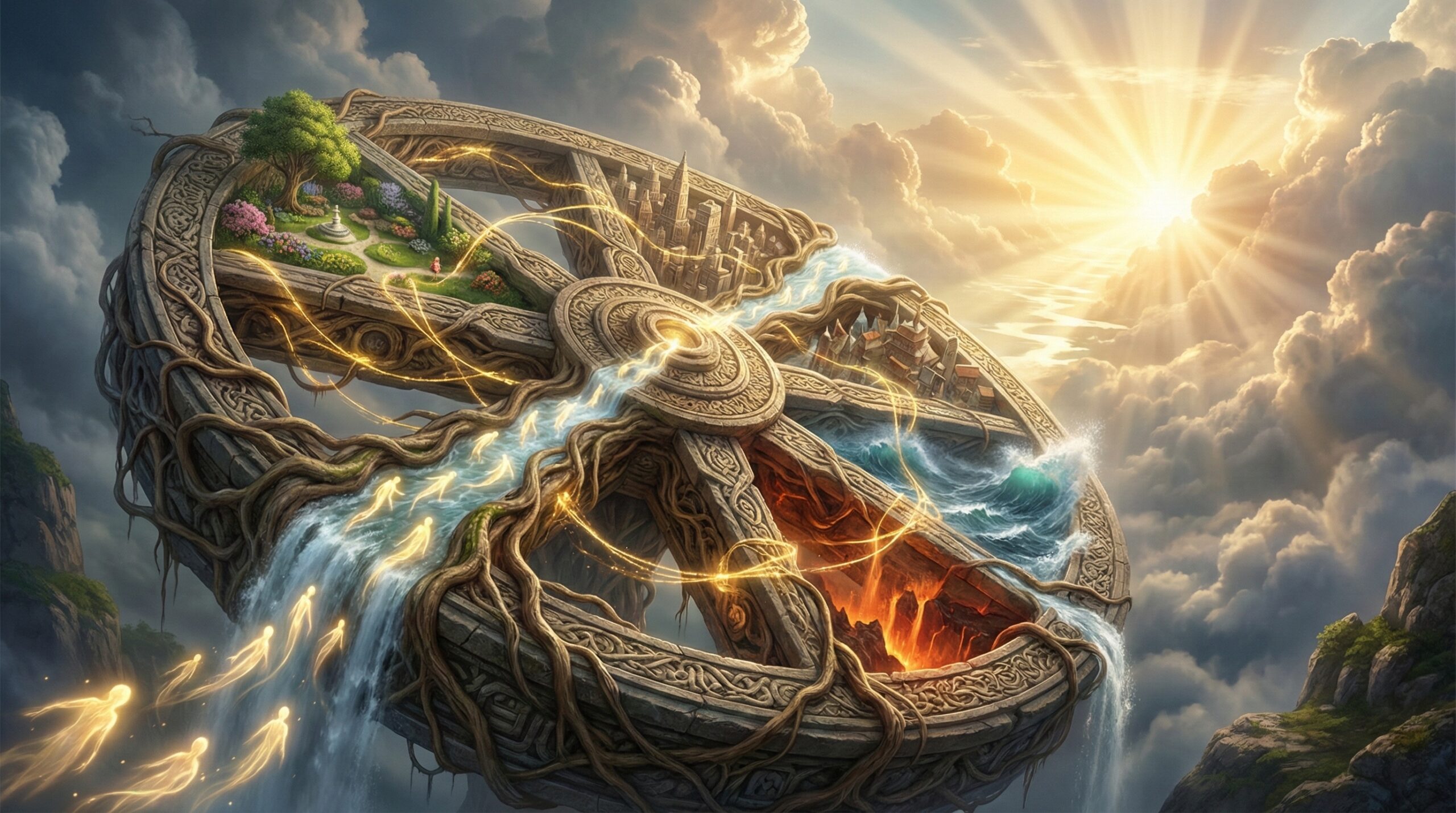
“轮回”并非指灵魂在不同身体之间的神秘旅行,也不是某种道德审判制度。在佛法语境中,轮回是对生命经验如何在因果与认知条件下持续展开的一种结构性描述。理解轮回,关键不在于想象“前世来世”,而在于看清:苦为何不断重复。
从定义上说,轮回指的是在无明与执取作用下,身心活动持续生成、持续受苦、持续延续的过程。它不是某个空间或世界的名称,而是一种运行机制。当导致苦的条件不被解除,生命经验便以不同形式反复出现,这种反复本身即是轮回。
佛法中的轮回并不以“灵魂实体”为前提。佛陀明确否定一个恒常不变、独立存在的自我。若不存在固定不变的主体,也就不存在一个“东西”从此生搬运到来生。轮回所延续的,并非实体,而是因果关系:行为的倾向、认知的模式、执取的力量。
轮回的核心动力是无明。无明不是知识不足,而是对现实结构的根本误认:将无常视为常,将条件组合视为自我,将过程误认为主体。在无明之下,执取产生,对存在、感受、身份与延续的抓取,使行为不断被驱动。由此形成业,而业并非命运,而是可预测的因果结果。
业在轮回中的作用,常被误解为“善恶记账”。实际上,业指的是带有意向的行为所形成的因果惯性。某种行为反复发生,便塑造相应的心行结构;相应的心行结构,又在适当条件下生成相应的经验结果。轮回并非审判,而是因果的持续展开。
从这一角度看,轮回并不只发生在“生与生之间”,也发生在当下。一个念头的生起、执取、失落、再度追逐,本身就是微观轮回。贪欲反复出现,焦虑反复生成,身份不断被建构又被威胁,这些循环若不被看清,便在宏观与微观层面同时运作。
佛法讨论轮回,并非为了制造恐惧,而是为了指出问题的深度。若苦只存在于一生之内,问题相对有限;若苦源于一种持续的认知机制,则必须从根本上处理。轮回的提出,是为了说明:仅靠环境改变、身份更换或短暂快乐,无法终止苦的重复。
轮回的止息,被称为解脱或涅槃。这并不是“跳出轮回到另一个地方”,而是轮回机制本身的停止。当无明被洞见,当执取不再运作,业失去继续推动的力量,经验不再以苦的方式被制造。轮回因此终结,不是被逃离,而是不再成立。
因此,轮回并非一种宇宙神话,而是一种关于经验如何被生产、维持与重复的分析模型。是否接受轮回,不取决于信仰,而取决于是否看见:在未觉察的情况下,苦确实在不断重演。佛法所做的,只是将这一事实清楚地指出来。
Date: 06/01/2024 06/02/2024
Location: Star Ocean Meditation Center
Teacher: Sara
Dharma Knowledge
What Is Rebirth (Samsara)
In the Dharma, rebirth—or samsara—does not refer to a soul traveling mysteriously between bodies, nor to a system of moral judgment imposed by an external power. It is a structural description of how lived experience continues under conditions of causality and misperception. To understand samsara is not to speculate about past and future lives, but to see why suffering repeats.
By definition, samsara is the ongoing process by which mental and physical experience is continuously generated and sustained through ignorance and attachment. It is not a place or a realm, but a mode of operation. When the conditions that produce suffering remain intact, experience continues to arise in repetitive forms. This repetition itself is samsara.
The Buddhist account of samsara does not rely on a permanent soul. The Buddha explicitly rejected the notion of an unchanging, independent self. Without such an entity, nothing “moves” from one life to another. What continues is not a substance, but a causal stream: behavioral tendencies, cognitive patterns, and the momentum of attachment.
The primary driver of samsara is ignorance. Ignorance is not a lack of information, but a fundamental misreading of reality—taking the impermanent to be permanent, conditional processes to be a self, and ongoing activity to be a stable subject. From this misperception arises attachment: the impulse to cling to existence, sensation, identity, and continuity. Action follows, and with action comes karma—not as fate, but as predictable causal consequence.
Karma is often misunderstood as moral bookkeeping. In fact, it refers to the causal inertia created by intentional action. Repeated actions shape mental structures; those structures, under suitable conditions, generate corresponding experiences. Samsara is not judgment, but continuity driven by cause and effect.
Seen this way, samsara is not limited to the transition between lifetimes. It is also present moment by moment. The arising of desire, the act of clinging, the loss that follows, and the renewed pursuit—this cycle is a micro-level samsara. Anxiety recurring, identity repeatedly constructed and threatened, craving endlessly renewed: these patterns operate simultaneously on immediate and extended scales.
The purpose of discussing samsara is not to instill fear, but to clarify the scope of the problem. If suffering were confined to a single lifetime, its resolution might be superficial. If suffering arises from a persistent cognitive mechanism, then only a fundamental correction will suffice. Samsara explains why changes in circumstance, role, or pleasure cannot end suffering by themselves.
The cessation of samsara is liberation, or nirvana. This does not mean escaping to another realm, but the stopping of the samsaric mechanism itself. When ignorance is seen through and attachment no longer operates, karma loses its driving force. Experience is no longer produced in the form of suffering. Samsara ends not by departure, but by non-production.
Samsara, therefore, is not a cosmological myth. It is an analytical model describing how experience is generated, maintained, and repeated. Accepting it does not require belief, but observation. The Dharma simply points out that, when unexamined, suffering does indeed repeat—and that this repetition has a cause that can be understood and ended.