时间:03/15/2025 03/16/2025
地点:星海禅修中心
主讲:Otto Huang
佛法修行
锐利的阿支罗迦叶
朝闻道,朝入涅槃
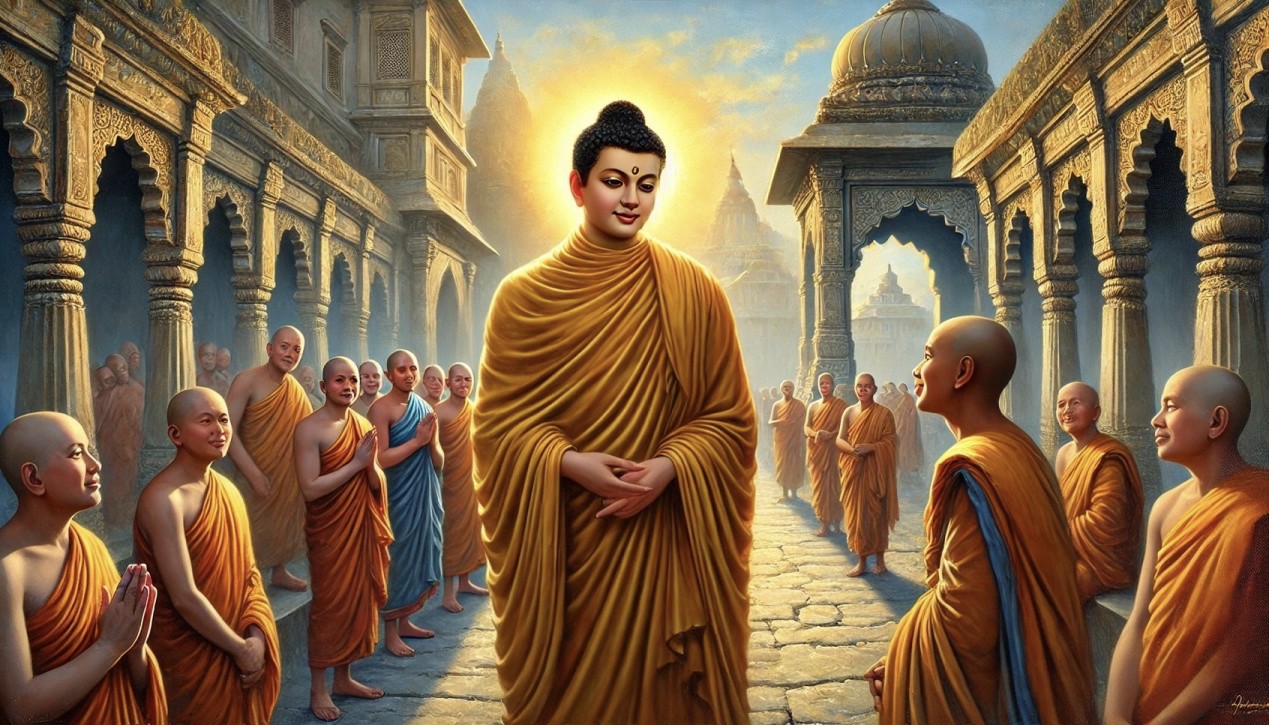
有一天早上,佛陀正走在往王舍城的路上,打算进城乞食,而阿支罗迦叶正好要办点事,从王舍城里走出来。
阿支罗迦叶远远地看到佛陀迎面走来,赶紧拦住佛陀,请求佛陀说:
「瞿昙!我有点问题想请教你,可以耽搁你一些时间吗?」
「迦叶!现在不是时候,我正要进城乞食,回来再为你解答好了。」
「瞿昙!只耽搁你一点时间,好吗?」
「迦叶!现在不是时候,回来再说吧。」
「瞿昙!为何不现在答应我?你这样不就是拒绝我吗?就只问一个小问题而已,请为我解说吧!」
「好吧,迦叶!你就问吧。」
「瞿昙!我们的苦,是自作的吗?」
「迦叶!不是这样的,你这样问,我无从谈起。」
「那苦是他作的吗?」
「迦叶!这样问这也无从谈起。」
「是自他共作的吗?」
「迦叶!这样问还是无从谈起。」
「那是非自、非他的无因作吗?」
「迦叶!更不是这样的。」
「瞿昙!我问苦是自作、他作、自他作、或无因作,你都不作『是』或『不是』的正面回答,而说无从谈起,那到底还有苦吗?」
「迦叶!苦确实是有的。」
「瞿昙!那你是不知苦、不见苦,所以无法直接回答我的问题喽?」
「迦叶!我不是不知苦、不见苦,迦叶!我知苦、见苦。」
「瞿昙!那请为我解说苦,让我也能知苦、见苦。」
「迦叶!如果之前的作者,与之后的受苦者是同一的,那就可以回答你:『苦是自作的』。然而,这么一来,作者与受者恒常不变,这不符合无常的事实,是错误的『常见』。
如果之前的作者,与之后的受苦者是相异的,那就可以回答你:『苦是他作的』。然而,这么一来,作者与受者可以没有关联,这也不符合实际情况,是错误的『断见』。
如果前面说的自作、他作能成立,那就可以回答你:『苦是自、他共作的』。然而,自作、他作都是错误的,所以我不说苦是自、他共作的。
如果因为不是自、他共作,而说苦是无因而生的,我也不会这么说。
离开这种种极端的错误想法,从合于事实的角度来说,那是:此有故彼有,此起故彼起;详细来说,即是:由于无明而有行,由于行而有识,由于识而有名色,由于名色而有六入处,由于六入处而有触,由于触而有受,由于受而有爱,由于爱而有取,由于取而有有,由于有而有生,由于生而有忧悲恼苦、纯大苦的聚集。
反之,此无故彼无,此灭故彼灭;当无明灭尽无余,行就灭了;行灭了,识就随着灭了;识灭了,名色就随着灭了;名色灭了,六入处就随着灭了;六入处灭了,触就随着灭了;触灭了,受就随着灭了;受灭了,爱就随着灭了,爱灭了,取就随着灭了;取灭了,有就随着灭了;有灭了,生就随着灭了,生灭了,所有的忧悲恼苦、纯大苦的聚集就随着灭了。」
阿支罗迦叶听了这样的解说后,深受震撼,打破了过去错误的思惟,当下远尘离垢,得法眼清净,见法、得法;知法、入法,不再疑惑,不再畏惧,合掌对佛陀说:
「世尊!现在,我已经了解了。从现在起,我皈依佛、法、僧,愿意终身为佛弟子,请为我见证。」
说完之后,阿支罗迦叶就拜别佛陀,去做他的工作了。但离开佛陀不久,阿支罗迦叶遭到一头保护小牛的母牛攻击,受伤而死了。死的时候,面貌安详平和。
世尊则继续他的王舍城乞食,不知道阿支罗迦叶在离开他不久后就死了。
其它比丘听说阿支罗迦叶遭到牛只攻击而死,就在用餐完毕后,来向佛陀报告,并好奇地请问佛陀,阿支罗迦叶得了什么成就,往生到哪里了。
佛陀告诉比丘们说,阿支罗迦叶知法、见法,死时无所执着,已经入涅槃解脱了。这样,佛陀为阿支罗迦叶授证得解脱的「第一记」。
Date: 03/15/2025 03/16/2025
Location: Star Ocean Meditation Center
Teacher: Otto Huang
Dharma Talk
The Sharp-Witted Ajiraka Kāśyapa
Hearing the Dhamma in the Morning, Entering Nirvana in the Morning
One morning, as the Buddha was walking along the road to Rājagaha, preparing to enter the city for alms, Ajiraka Kāśyapa happened to be coming out of the city to attend to some matters.
Seeing the Buddha approaching from a distance, Ajiraka Kāśyapa quickly stepped forward to stop him and requested:
”Gotama! I have some questions I wish to ask you. May I take up a bit of your time?”
”Kāśyapa! Now is not the right time. I am about to enter the city for alms. I will answer your questions when I return.”
”Gotama! It will only take a short moment. Please?”
”Kāśyapa! Now is not the right time. Let us speak after I return.”
”Gotama! Why do you refuse me? Are you rejecting my request? It is just a small question. Please explain it to me!”
”Very well, Kāśyapa! Ask your question.”
”Gotama! Is our suffering self-created?”
”Kāśyapa! That is not how it is. If you ask in this way, I have no basis for discussion.”
”Then is suffering created by others?”
”Kāśyapa! If you ask in this way, I still have no basis for discussion.”
”Is it created by both self and others?”
”Kāśyapa! Asking in this way still provides no basis for discussion.”
”Then is suffering causeless, arising without reason?”
”Kāśyapa! That is not the case either.”
”Gotama! I asked whether suffering is self-created, other-created, both self- and other-created, or causeless, and you did not answer either ‘yes’ or ‘no,’ only saying that there is no basis for discussion. So, does suffering exist at all?”
”Kāśyapa! Suffering does indeed exist.”
”Gotama! Then do you not know suffering, do you not see suffering, so that you cannot answer my question directly?”
”Kāśyapa! It is not that I do not know suffering or do not see suffering. Kāśyapa! I do know suffering, and I do see suffering.”
”Gotama! Then please explain suffering to me so that I, too, may know and see suffering.”
”Kāśyapa! If the one who acted in the past and the one who experiences suffering afterward were the same, then I could answer you by saying, ‘Suffering is self-created.’ However, in that case, the agent and the experiencer would be permanently unchanging, which contradicts the reality of impermanence. This would be the erroneous view of ‘eternalism.’
If the one who acted in the past and the one who experiences suffering afterward were entirely different, then I could answer you by saying, ‘Suffering is created by others.’ However, in that case, the agent and the experiencer would be completely unrelated, which also does not align with reality. This would be the erroneous view of ‘annihilationism.’
If both self-creation and other-creation were valid, then I could answer you by saying, ‘Suffering is created by both self and others.’ However, since both self-creation and other-creation are incorrect, I do not state that suffering is created by both.
If, because it is not self-created or other-created, one were to claim that suffering arises without cause, I would not say so either.
Leaving aside these extreme mistaken views, and instead considering the matter in accordance with reality, it is thus: ‘When this exists, that exists; when this arises, that arises.’ More specifically:
Due to ignorance, volitional formations arise;
Due to volitional formations, consciousness arises;
Due to consciousness, name-and-form arise;
Due to name-and-form, the six sense bases arise;
Due to the six sense bases, contact arises;
Due to contact, feeling arises;
Due to feeling, craving arises;
Due to craving, clinging arises;
Due to clinging, becoming arises;
Due to becoming, birth arises;
Due to birth, there arise sorrow, lamentation, pain, grief, and despair—thus is the arising of this whole mass of suffering.
Conversely, ‘When this ceases, that ceases; when this is extinguished, that is extinguished.’ When ignorance is completely eradicated, volitional formations cease;
When volitional formations cease, consciousness ceases;
When consciousness ceases, name-and-form cease;
When name-and-form cease, the six sense bases cease;
When the six sense bases cease, contact ceases;
When contact ceases, feeling ceases;
When feeling ceases, craving ceases;
When craving ceases, clinging ceases;
When clinging ceases, becoming ceases;
When becoming ceases, birth ceases;
When birth ceases, all sorrow, lamentation, pain, grief, and despair—the entire mass of suffering—cease as well.”
Upon hearing this explanation, Ajiraka Kāśyapa was deeply shaken. His previous erroneous thoughts were shattered, and at that moment, he became free from all defilements, attained the purity of the Dhamma-eye, realized the truth, and understood the Dhamma.
He comprehended the truth, entered the Dhamma, and was no longer doubtful or fearful. He joined his palms together in reverence and said to the Buddha:
”Blessed One! Now, I have understood. From this moment forward, I take refuge in the Buddha, the Dhamma, and the Saṅgha. I wish to be your disciple for life. Please bear witness to this.”
Having said this, Ajiraka Kāśyapa took leave of the Buddha and went on his way to carry out his work. However, not long after parting from the Buddha, he was attacked by a mother cow protecting her calf. He was injured and died. When he passed away, his face was peaceful and serene.
The Blessed One continued his alms round in Rājagaha, unaware that Ajiraka Kāśyapa had died shortly after leaving him.
Later, other bhikkhus heard that Ajiraka Kāśyapa had been fatally attacked by a cow. After their meal, they approached the Buddha and, curious, asked about Ajiraka Kāśyapa’s fate—what attainment he had reached and where he had been reborn.
The Buddha told the bhikkhus that Ajiraka Kāśyapa had realized and seen the Dhamma. At the time of his death, he was without attachment and had attained complete Nirvana, liberation. Thus, the Buddha confirmed Ajiraka Kāśyapa’s final liberation, giving him the first declaration of attainment.