Date: 01/17/2026 01/18/2026
Location: Star Ocean Meditation Center
Teacher: Jason
Dharma Talk
Protect Right Mindfulness as One Would Guard a Bowl of Oil
In the past, the Venerable Kātyāyana, together with his retinue, was traveling on foot and arrived at the kingdom of Ujjayinī. As soon as they entered the city, half of all calamities and diseases within the city were immediately dispelled.
The gatekeeper reported to the king: “Your Majesty, do you know this? Five hundred bhikṣus of exceptionally dignified deportment have just entered the city, and the city’s disasters have already subsided by half.”The king replied, “This is truly auspicious. They should be offered support.”
At that time, the Brahmins of the city also came to report to the king: “We have been tirelessly performing rituals day and night to avert calamities. It is by our power that these disasters have been reduced by half. Before long, they will be completely eliminated. How can this be attributed to those bhikṣus?”
After the bhikṣus arrived at the palace, they offered blessings to the king, saying, “May Your Majesty be free from illness and enjoy long life.” Having spoken thus, they took leave of the king and departed.
The king then said to his ministers: “The gatekeeper says, ‘Five hundred bhikṣus of extraordinary deportment have just entered the city, and the disasters have subsided by half.’ Yet the Brahmins say, ‘It is through our ritual efforts that the disasters have been reduced by half and will soon be entirely eliminated; it has nothing to do with outsiders.’ I truly do not know to whom this merit belongs.
Ministers, now take both the bhikṣus and the Brahmins to the elephant stable. In an unclean place, give them coarse rice cakes soaked in sour gruel to eat. After they have eaten and are about to leave, ask them separately, ‘How was the meal prepared by the king today?’”
Accordingly, the ministers followed the king’s instructions and arranged the meal in the elephant stable, offering it to both the bhikṣus and the Brahmins. After they had eaten and were about to depart, the gatekeeper first asked the Brahmins, “You have received the king’s offering today. How did you find the meal?”
The Brahmins became enraged and exclaimed loudly, “This is improper! That stingy king actually offered coarse rice cakes soaked in sour gruel to Brahmins. How could such conduct yield any merit?”Hearing this, the gatekeeper remained silent.
After the Brahmins departed, the bhikṣus also came out. The gatekeeper then asked them, “Venerable ones, how was the meal offered by the king?”
The bhikṣus replied, “Good sir, whatever food is given by the donor should be accepted. This meal is sufficient to sustain the body day and night.”
The gatekeeper reported in detail to the king the differing responses of the two groups. After hearing this, the king again instructed his ministers: “Now return to the elephant stable, find a clean place, prepare exquisite delicacies, and question them again in the same manner.”
The ministers then laid out seats in a clean area of the elephant stable and respectfully offered fine and delicious food to both the Brahmins and the bhikṣus. After they had eaten and were about to leave, they were questioned again as before.
The Brahmins said, “Today’s meal was as splendid and rare as a grand banquet prepared by a consecrated kṣatriya king. May Your Majesty receive immeasurable merit!”
The gatekeeper responded, “Matters of the royal kitchen are never uniformly judged. Why, then, did you not ridicule or disdain it today?”
The Brahmins fell silent and departed. When the bhikṣus were questioned again, their answer was exactly the same as before.
The gatekeeper returned to the palace and reported everything to the king. The king then ordered the ministers to repeat the experiment in the horse stable as well. The results showed that whether in the elephant stable or the horse stable, whether the environment was clean or filthy, and whether the food was refined or coarse, the bhikṣus’ responses were always consistent.
After hearing the report, the king’s faith greatly increased, and he thought to himself, “These bhikṣus are truly a field of merit.” The king immediately went to where the Venerable Kātyāyana was staying. After respectfully prostrating himself, he sat to one side.
The Venerable Kātyāyana taught the Dharma to the king, who rejoiced upon hearing it and received its benefit. The king again bowed and said, “May the Venerable One show compassion and, together with the noble Saṅgha, come to the palace tomorrow to accept my offering.”
The Venerable One silently consented. The king bowed once more and took his leave.
That night, the king prepared excellent food. Early the next morning, he arranged seats, set up vessels of pure water, and sent a messenger to inform the Venerable One: “The meal is ready. May the noble ones come as agreed.”At daybreak, the Venerable Kātyāyana took up his robes and bowl, led the bhikṣus to the place of offering, and they sat down in proper order.
At that time, the king ordered singers and dancers to perform various kinds of music. Yet the Venerable One and the bhikṣus restrained their sense faculties, sitting upright and composed. When the music ended, the king asked the Venerable One, “How was the music just now? Was it satisfactory?”
The Venerable One replied, “Great King, only those who see and hear can know whether it is good or bad.”
The king said, “Those whose six faculties are dull might not know, but you are keen of eye and ear—how could you not have seen or heard it?”
In order to make the king understand, the Venerable One skillfully said, “Great King, is there now in the city a prisoner who is about to be executed?”
The king asked, “What do you need such a person for?”
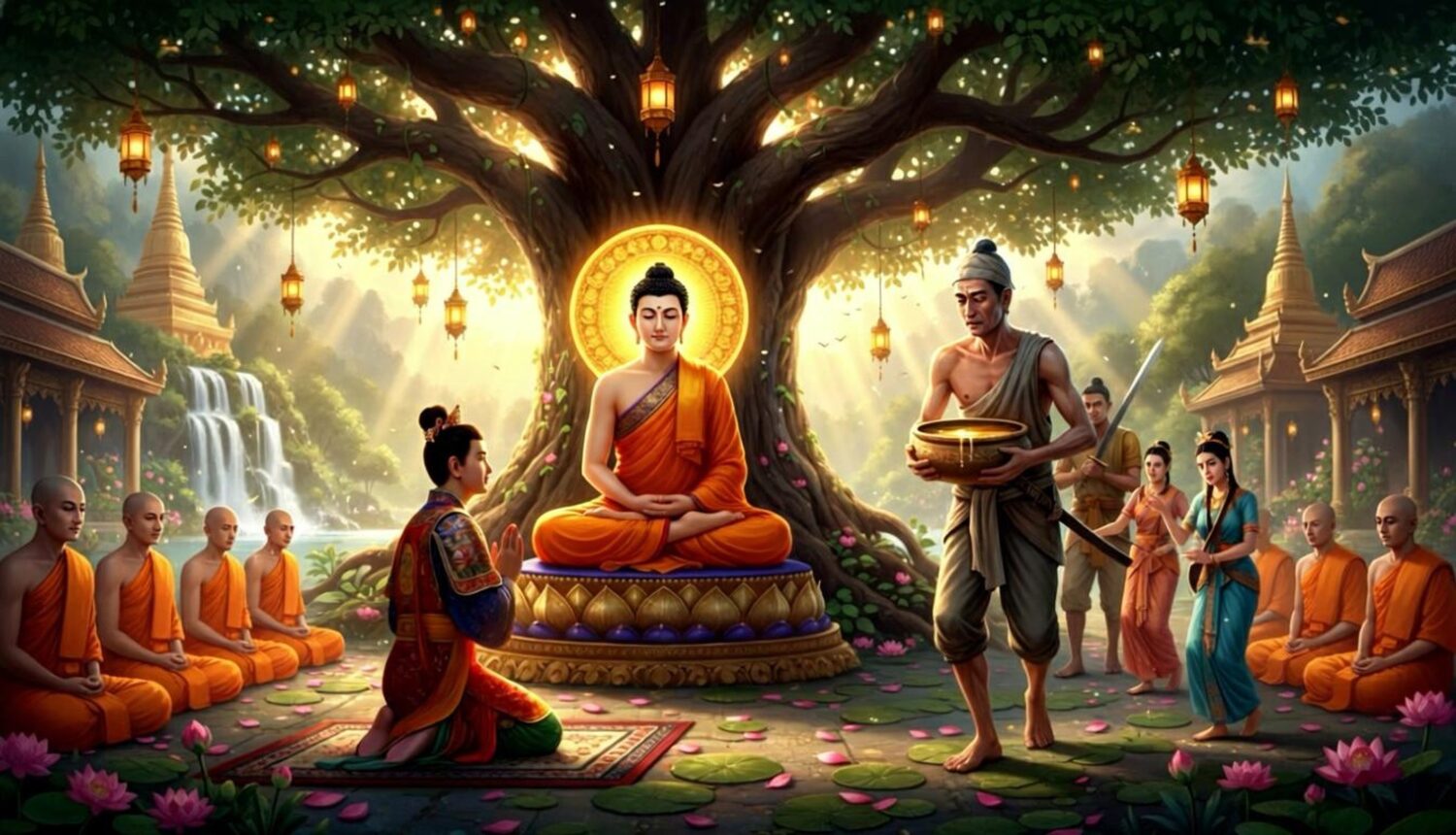
The Venerable One said, “Great King, have a bowl filled to the brim with oil placed in his hands. Then assign someone to follow him with a sword, threatening him: ‘If a single drop of oil spills onto the ground, you will be executed immediately.’ Allow him to walk freely, and along his path arrange various songs, dances, and entertainments.
When he returns, ask him, ‘How were the appearances of the women and the music that was played?’ In this way, Great King, you will truly believe what I have said.”
The king carried out the instructions exactly as told. When the prisoner carefully returned holding the bowl of oil, the king asked him, “How were the appearances of the women and the music that was played?”
The prisoner replied, “Great King, only those who see and hear can know whether it was good or bad.”
The king asked, “You clearly have eyes and ears—how could you not have seen or heard?”
The prisoner said, “Great King, if even a single drop of oil had spilled from the bowl in my hands, the man with the sword would have executed me. At that moment, I was only concerned that the bowl might tilt and feared losing my head. With my entire attention focused on holding the bowl, I had no leisure to notice the women’s appearances or the quality of the music.”
Hearing this, the king fell silent.
The Venerable One then asked the king, “Great King, do you see now?”
The king replied, “I see.”
The Venerable One continued, “This prisoner, merely in order to preserve his life, concentrated his whole mind, maintained right mindfulness, and dared not indulge in the slightest negligence, carefully guarding himself.
How much more so for us renunciant bhikṣus, who understand that such music and sensual pleasures are the causes of suffering accumulated over countless lifetimes. Having long since abandoned them, how could we still wish to look at or listen to them?”
The king contemplated this principle deeply and developed even greater reverence for the Venerable Kātyāyana.