Date: 06/01/2024 06/02/2024
Location: Star Ocean Meditation Center
Teacher: Sara
Dharma Knowledge
What Is Rebirth (Samsara)
In the Dharma, rebirth—or samsara—does not refer to a soul traveling mysteriously between bodies, nor to a system of moral judgment imposed by an external power. It is a structural description of how lived experience continues under conditions of causality and misperception. To understand samsara is not to speculate about past and future lives, but to see why suffering repeats.
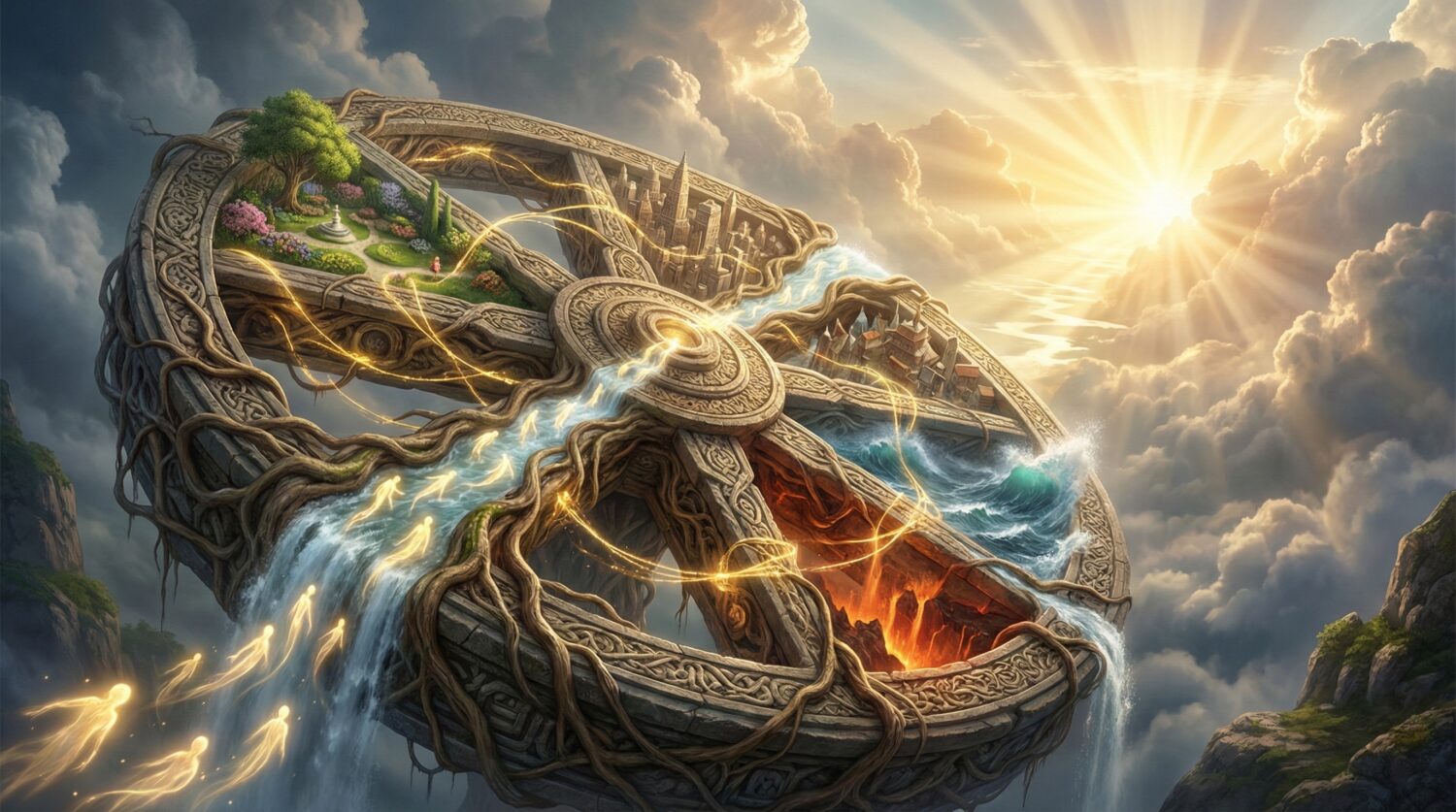
By definition, samsara is the ongoing process by which mental and physical experience is continuously generated and sustained through ignorance and attachment. It is not a place or a realm, but a mode of operation. When the conditions that produce suffering remain intact, experience continues to arise in repetitive forms. This repetition itself is samsara.
The Buddhist account of samsara does not rely on a permanent soul. The Buddha explicitly rejected the notion of an unchanging, independent self. Without such an entity, nothing “moves” from one life to another. What continues is not a substance, but a causal stream: behavioral tendencies, cognitive patterns, and the momentum of attachment.
The primary driver of samsara is ignorance. Ignorance is not a lack of information, but a fundamental misreading of reality—taking the impermanent to be permanent, conditional processes to be a self, and ongoing activity to be a stable subject. From this misperception arises attachment: the impulse to cling to existence, sensation, identity, and continuity. Action follows, and with action comes karma—not as fate, but as predictable causal consequence.
Karma is often misunderstood as moral bookkeeping. In fact, it refers to the causal inertia created by intentional action. Repeated actions shape mental structures; those structures, under suitable conditions, generate corresponding experiences. Samsara is not judgment, but continuity driven by cause and effect.
Seen this way, samsara is not limited to the transition between lifetimes. It is also present moment by moment. The arising of desire, the act of clinging, the loss that follows, and the renewed pursuit—this cycle is a micro-level samsara. Anxiety recurring, identity repeatedly constructed and threatened, craving endlessly renewed: these patterns operate simultaneously on immediate and extended scales.
The purpose of discussing samsara is not to instill fear, but to clarify the scope of the problem. If suffering were confined to a single lifetime, its resolution might be superficial. If suffering arises from a persistent cognitive mechanism, then only a fundamental correction will suffice. Samsara explains why changes in circumstance, role, or pleasure cannot end suffering by themselves.
The cessation of samsara is liberation, or nirvana. This does not mean escaping to another realm, but the stopping of the samsaric mechanism itself. When ignorance is seen through and attachment no longer operates, karma loses its driving force. Experience is no longer produced in the form of suffering. Samsara ends not by departure, but by non-production.
Samsara, therefore, is not a cosmological myth. It is an analytical model describing how experience is generated, maintained, and repeated. Accepting it does not require belief, but observation. The Dharma simply points out that, when unexamined, suffering does indeed repeat—and that this repetition has a cause that can be understood and ended.