Date: 03/30/2024 03/31/2024
Location: Star Ocean Meditation Center
Teacher: Sara
Dharma Knowledge
The Relationship Between the Buddha and His Disciples
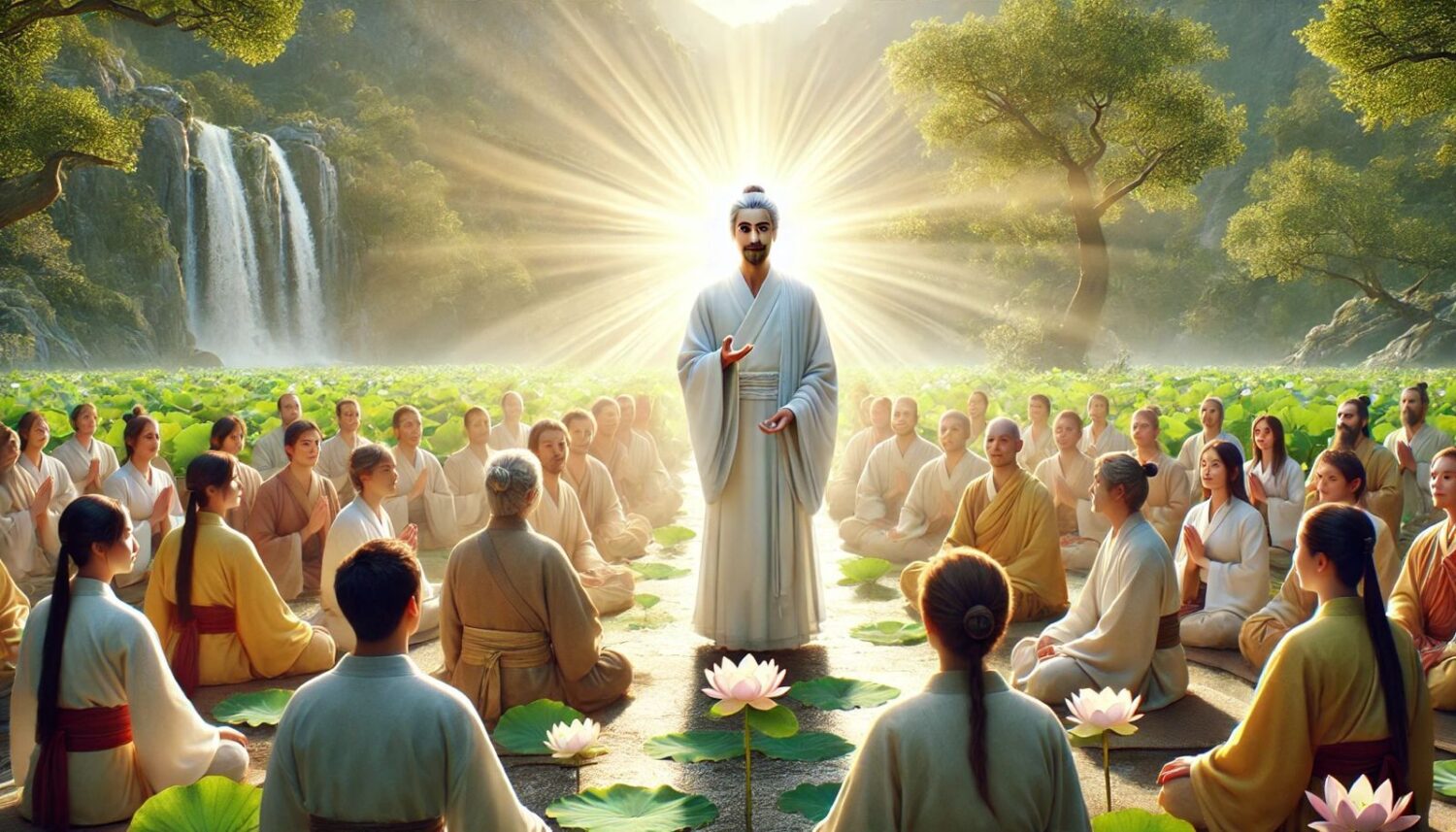
The relationship between the Buddha and his disciples is often misunderstood as a religious hierarchy between master and believers, or as a moral hierarchy between a saint and followers. From the internal logic of the Dharma, such interpretations are inaccurate. The relationship was fundamentally instructional and methodological, not one of authority, faith-based obedience, or personal devotion.
First, the Buddha did not position himself as an absolute authority. Although awakened, he never demanded acceptance of his teachings based on his status. On the contrary, he consistently emphasized that all teachings must be verified through personal experience. Disciples were not asked to believe that the Buddha was right, but to examine whether what he pointed out was in fact true. His role was that of a guide, not a judge.
Second, the relationship was not built on obedience. The Buddha did not establish a system centered on personal command. The disciplinary rules were not divine decrees but practical tools derived from causal analysis, intended to reduce disturbance and enable clarity. Disciples followed them not out of submission, but because they understood their function. The foundation of the relationship was comprehension, not power.
In teaching, the Buddha employed a highly adaptive approach. He did not deliver identical formulations to all disciples, but adjusted explanations according to each person’s disposition, attachments, and cognitive capacity. This indicates that disciples were treated as active practitioners, not passive recipients. The relationship was participatory rather than transmissive.
The Buddha also allowed and encouraged questioning. Canonical texts record disciples openly challenging, doubting, or expressing confusion. These exchanges were not regarded as disrespectful, but as opportunities for clarification and refinement. This interaction resembles a research or training environment more than a theological authority structure.
Importantly, the Buddha did not assume responsibility for the final outcome of his disciples. He never promised liberation through association alone. Liberation depended entirely on whether the individual truly understood and practiced the Dharma. Even close proximity to the Buddha did not guarantee awakening if attachment remained. This directly contradicts the religious notion of salvation through proximity to a sacred figure.
In his final instructions, the Buddha clarified this relationship decisively. He appointed no successor and designated no personal authority, stating instead that the Dharma itself should be the teacher. After his passing, legitimacy would not depend on closeness to the Buddha, but on fidelity to understanding and effectiveness in reducing ignorance and attachment.
Thus, the relationship between the Buddha and his disciples was neither emotional dependency nor moral hierarchy. It was a strictly functional relationship: one clarified structure and method, the other undertook understanding and practice. Once understanding was complete, the relationship could dissolve naturally. The Buddha required no worship, and the disciple no perpetual guidance.
From the standpoint of the Dharma, the ideal teacher–student relationship is one that eventually makes itself unnecessary. The relationship between the Buddha and his disciples was completed precisely through its own dissolution.