Date: 12/09/2023 12/10/2023
Location: Star Ocean Meditation Center
Teacher: Laura
Dharma Knowledge
Is the Dharma a religion?
This is a question frequently raised in modern discussions of Buddhism. Many people find that the Dharma resembles religion in some ways, yet differs from what they usually associate with religion. To understand this question properly, it is necessary to look at the Dharma from multiple perspectives rather than relying on a single definition.
In common usage, religion is often centered on belief in a god or supernatural authority, along with worship, rituals, and divine commandments. The Dharma, however, does not begin with belief in a creator or supreme being. The Buddha did not present himself as a god, nor did he claim that the world is governed by divine will. Instead, the focus of the Dharma is the problem of suffering and the possibility of its cessation.
At its core, the Dharma emphasizes understanding and awakening rather than faith-based obedience. The Buddha encouraged people to observe their own experience and to see how impermanence, attachment, and ignorance give rise to distress. Insight in the Dharma arises through reflection and practice, not through acceptance of dogma. From this perspective, the Dharma appears less like a belief system and more like a path of inquiry and realization.
Nevertheless, from a historical and social viewpoint, the Dharma clearly exists within a religious framework. Over centuries, it developed into Buddhism, complete with scriptures, monastic institutions, ethical codes, rituals, and communal traditions. As Buddhism spread across cultures, it adopted various religious forms, making it recognizable as a world religion.
What makes the Dharma distinctive is that its religious dimension does not demand exclusive belief. One does not need to identify as Buddhist in order to benefit from its teachings. The Buddha emphasized testing the teachings in one’s own life, accepting them only insofar as they lead to reduced suffering and greater clarity. This openness sets the Dharma apart from many conventional religious models.
In practice, the Dharma is concerned primarily with training the mind rather than establishing religious identity. Practices such as mindfulness, ethical awareness, concentration, and compassion can be cultivated by anyone, regardless of cultural or religious background. This universality allows the Dharma to function beyond institutional boundaries.
In contemporary society, many people approach the Dharma as a form of life wisdom or mental discipline rather than as a religion. This does not deny the existence of Buddhist religious traditions, but highlights the adaptability of the Dharma. It can support devotional and communal life, or it can be applied in secular contexts such as psychology, education, and personal development.
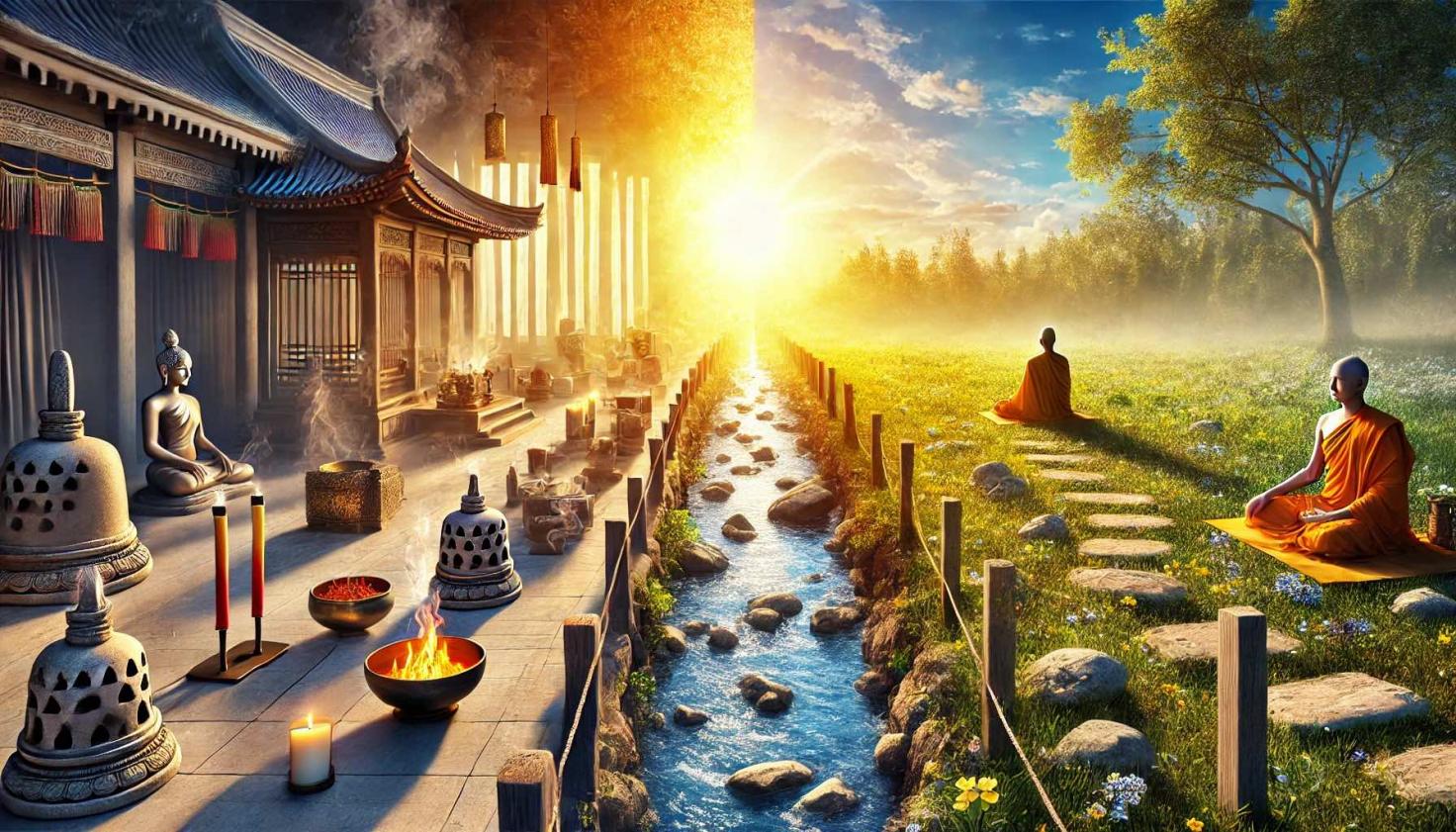
In conclusion, whether the Dharma is considered a religion depends on perspective. Socially and institutionally, it functions as one. At its core, however, it is a path of awakening that transcends fixed categories of belief. This dual nature—both religious and beyond religion—is one of the reasons the Dharma continues to remain relevant across cultures and generations.